
Compassionate Systems Site Development in California
This four-year research study, conducted by the MIT Systems Awareness Lab, explores key insights, themes, and emerging questions regarding implementing the Compassionate Systems Site Development program in PreK-12 education in California, United States.
Keywords: General Social Field | Systems Thinking | Systems Sensing | Systems Awareness | Systems Change | Capacity Building | Relational Awareness
“I came to this space really believing that if I was going to continue as an academic leader, I needed to do so in a way that I could humanize myself and those I was serving.”
–Education Administrator
Why Compassionate Systems?
The Compassionate Systems Site Development initiative in California responds to an ongoing challenge in education: the education system is an intrinsically relational web composed of students, teachers, parents, administrators, and other stakeholders, each with lived histories, emotions, and ingrained mental models shaped by their own, often decades-long, experience within the education system (see Figure 2), yet we often fail to account for that in traditional programs. The initiative is an applied, contextual systems change approach deliberately designed to address these relational and complex characteristics across different levels of the education system.
The study delves into the lived experiences of a diverse group of practitioners involved in the Compassionate Systems Site Development program, including professionals from a large U.S. state education system and the facilitators from a nonprofit organization who engaged in a multi-year effort focused on cultivating systems-aware, relationally-informed leadership capacities in educators, students and staff in pre K-12 classrooms, expanded learning (out-of-school) settings, and education administrative offices.
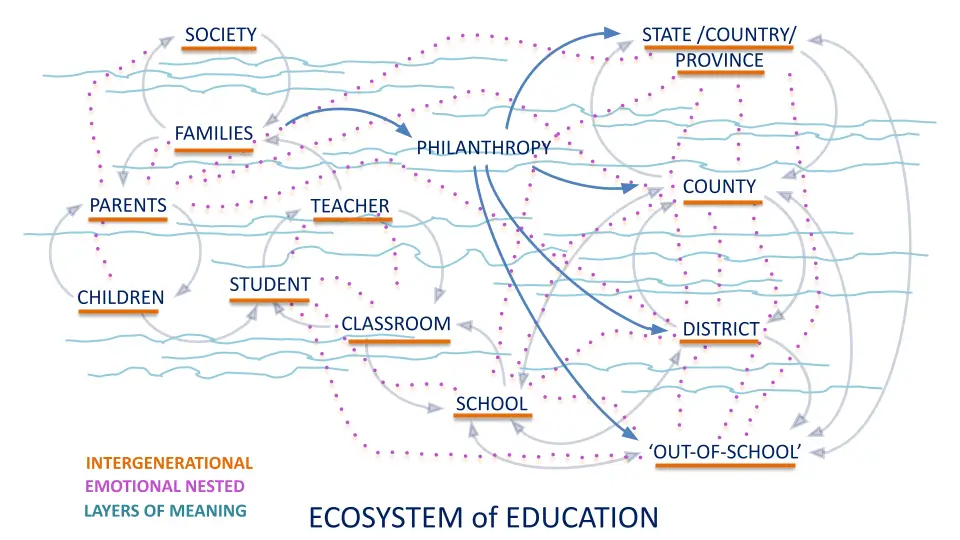
This study is a deep dive into the lived experiences of a diverse group of actors across different levels of the education system who are engaged in a multi-tiered effort focused on cultivating systems-aware, relationally-informed capacities to help them learn, practice, and integrate the Compassionate Systems Framework into their local contexts to navigate complex systems change.
The primary objectives of this study are, first, to document and learn from the Site Development implementation of the Compassionate Systems Framework, focusing on how communities can be supported in leading and sustaining living systems change. Second, to begin exploring the role of generative social fields as key enablers of shifts in behaviours and interactions across classrooms, schools, and districts and to examine how these shifts yield meaningful systems change in education.
Research Methods
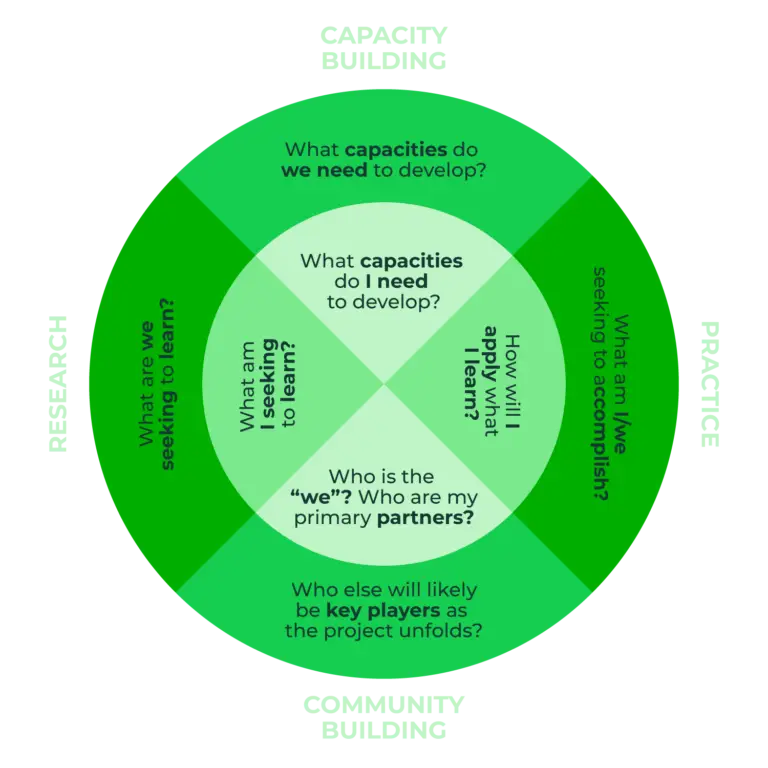
This study employed the Mandala for Systems Change as an analytic framework (Böll, 2023; Böll et al., 2025). The mandala brings together four interconnected areas: capacity building, practice, community building, and research. It serves both as a holistic framework and a practical tool for “holding the whole” of a change process, helping practitioners reflect on these domains. In this study, the mandala served as a method to study practitioners’ reflections on how change unfolded across these interconnected areas.
Research Presentation
Key Findings
“The outcome of the work would be that as adult humans working at the County Office of Education, we can be in relationship with one another and in spaces where we don’t align our thinking and we can hold the hard conversations with compassion and care.”
–Education Leader
Education Systems are Deeply Relational
The study’s findings speak to how deeply relational education systems are, including not only the relationships teachers have with their students, but also those between the state and county offices of education, counties and districts, districts and schools, superintendents, school boards, and principals, as well as the wide webs of students, teachers and aides, expanded learning educators, parents, and caregivers that make up all of our communities. The findings also point to the kinds of learning, practices, and infrastructure needed to shift those relationships.
Explore our relational map
Systems-Aware Relational Praxis: From Awareness to Practice to Enacted Change
Our findings show that the intentional use, adaptation, and reflection of tools and practices in the Compassionate Systems Framework enabled participants to develop not only intellectual understanding of interconnection and interdependency, but also the relational skills and emotional capacities to enact that understanding in real organisational difficulty and change. Practitioners reported a shift in their sensemaking, from conceiving isolated issues and linear cause-and-effect to recognising patterns, relationships, and the underlying structures that shape behaviour. This helped practitioners frame improvement as a collective challenge requiring coordinated action across multiple levels of the system.
Generative Social Fields Allow Us to Hold and Move Through Complexity
Our findings suggest that cultivating generative social fields (i.e., relational patterns in healthy, thriving communities) through systems-aware, relational competence creates an enabling environment for meaningful and sustained change across various levels of the education system. The quality of the social field itself is a central condition for educational change, and practitioners, equipped with tools and practices to develop their relational capacity, can shape such fields.
Program Implementation Learnings and Directions
- Capacity-building mattered because people needed the skills, confidence, and shared language to take part in shaping the social field.
- Practice enabled repeated routines such as grounding, check-ins, reflection, systems thinking, and inquiry that gave people concrete ways to enact different relational possibilities and accomplish practical changes in their educational practice.
- Community-building strengthened capacities and practices when shared, repeated, and embedded across groups learning together, rather than held by isolated individuals.
- Research was a foundational reflective process through which practitioners iterated their use and learning over time.
Future Directions for Research
An Emerging Research Framework for the Early Indicators of Systems Change
Our central emerging research framework is that, rather than claiming systems change happened in four years, the study identifies early indicators that a system may be shifting toward greater relational complexity and systems awareness. These include shifts in language that reflect shifts in mental models, shifts in relationships, and shifts in practice and action.
Future research is needed to better explore how these potential early indicators unfold across diverse contexts and at what frequency, depth, or number these shifts need to occur for systems-level change to be registered and sustained. We also see an opportunity to more deeply examine how generative social fields enable, structure, and sustain change processes.
Future research should further explore these questions: What conditions foster more generative social fields? How do generative social fields and relationships sustain over time, particularly when external support decreases or organisational leadership changes? What research approaches and methods could help us better explore the correlation between shifts in relational fields and measurable outcomes for students and families?
Research-Practitioner Partnerships
One of the most important takeaways is the need for more partnership with local site partners in co-designing future research. More participatory action research is needed to engage diverse stakeholders, especially students and youth, in designing, conducting and sensemaking to support the learning of their own communities, while contributing to the larger field of education.
Coming from these findings, we recommend a few key areas of inquiry: under what conditions do we see Compassionate Systems implementation as more successful? Less successful? Where is the context of the fit? At the individual and context levels, are there predispositions that make people more inclined to this work? What Compassionate Systems strategies and practices have been tried in different contexts? How can we improve the documentation and tracking of what is happening in local contexts?
Get involved
Questions, reflections, or interest in future research collaborations?
If you would like to continue the conversation, share your reflections, or explore opportunities for future research collaboration, please contact us at systemsawareness@mit.edu.
Research Team



Acknowledgements
Sponsors


Grace Charitable Foundation
Research Advisors
Peter Senge
Mette Miriam Böll
Eric Klopfer
Reviewers and Thoughts Partners
Kim Schonert-Reichl
Michael Fullan
Mark Greenberg
Linda Vanasupa
Jean Clinton
John Van Maanen
Rana Dajani
Research Interns
Karim Makie
Mohammad Elfadil